
Categories
Buying a HomePublished August 20, 2026
Mortgage Rates Hit a Four-Week Low: What Salem Buyers Should Know

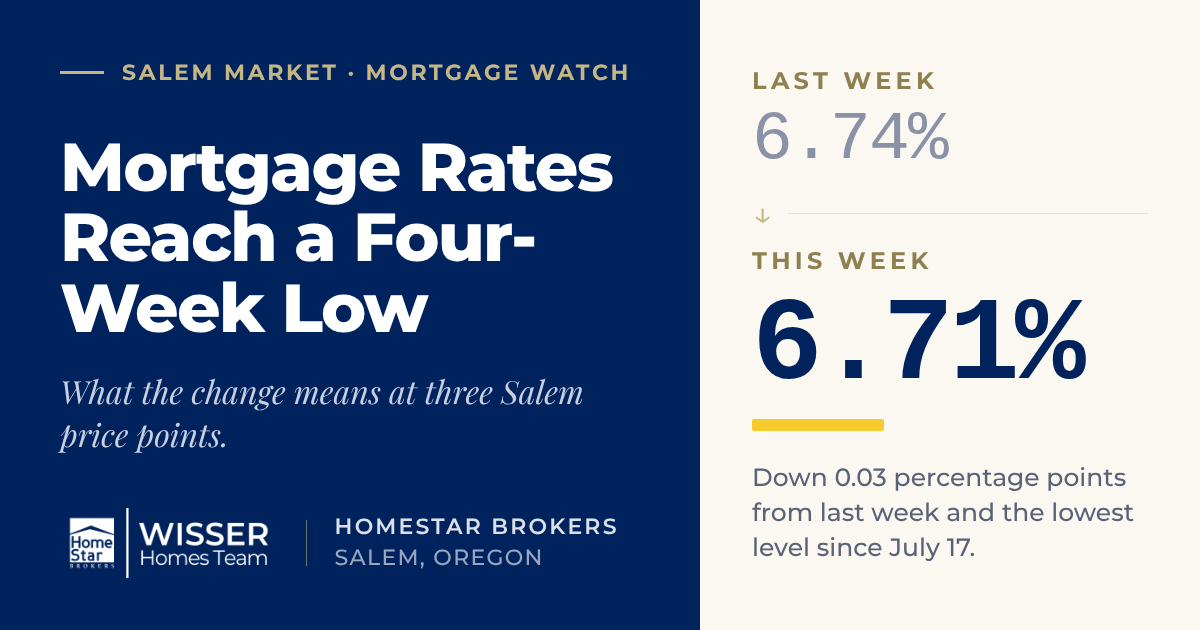
Mortgage rates finished the week of August 14 at their lowest levels since July 17. The national average 30-year fixed rate was 6.71%, down from 6.74% one week earlier, according to Mortgage News Daily data shared by local lender Ben Nelson of Synergy One Lending.
That is encouraging movement, but it is important to put it in perspective. A 0.03 percentage-point change does not transform affordability overnight. It produces a relatively small payment difference by itself. The more useful story is that several small improvements can accumulate, and buyers may be able to combine a better rate with price negotiation, seller concessions or a different loan structure.
Quick answer: On a 30-year fixed mortgage with 10% down, the move from 6.74% to 6.71% reduces estimated principal and interest by approximately $7 to $12 per month on homes priced from $400,000 to $650,000.
Why Did Mortgage Rates Improve?
The week included two important inflation reports. The Consumer Price Index was close to expectations and had little lasting effect on rates. The Producer Price Index, which measures inflation at the wholesale level, came in slightly below forecasts in several key areas. That helped bond yields move lower and allowed mortgage rates to reach a four-week low.
Rates moved slightly higher again on Friday, but mortgage-specific bonds held up comparatively well. The average 30-year fixed rate finished the week at 6.71%.
For additional national context, read Ben Nelson’s August 14 mortgage-market update.
What Does the Latest Rate Change Mean for a Monthly Payment?
The following examples assume a 30-year fixed mortgage with a 10% down payment. The payments include principal and interest only. Property taxes, homeowners insurance, mortgage insurance, homeowners association dues and other costs are not included.
| Home price | Loan amount | Payment at 6.74% | Payment at 6.71% | Monthly difference |
|---|---|---|---|---|
| $400,000 | $360,000 | $2,333 | $2,325 | $7 less |
| $500,000 | $450,000 | $2,916 | $2,907 | $9 less |
| $650,000 | $585,000 | $3,790 | $3,779 | $12 less |
The immediate savings are modest. That is worth saying plainly. Rate headlines can make a small movement sound more consequential than it is.
Why a Quarter-Point Rate Movement Matters More
A single weekly change may be small, but several rate improvements can add up. To illustrate the sensitivity of a payment to a larger movement, consider a hypothetical decline from 6.96% to 6.71%.
| Home price | Loan amount | Approximate monthly difference |
|---|---|---|
| $400,000 | $360,000 | $60 less |
| $500,000 | $450,000 | $75 less |
| $650,000 | $585,000 | $98 less |
This quarter-point comparison is an illustration, not the change that occurred during the week of August 14. It shows why buyers should watch the broader direction of rates without overreacting to a single day or weekly headline.
What Matters Besides the Mortgage Rate?
Mortgage rates are important, but they are only one part of a purchase. Depending on the home and the seller’s circumstances, one of the following may have a larger effect than this week’s rate movement.
- Purchase-price negotiation: A lower price reduces both the loan balance and the cash required at closing.
- Seller-paid closing costs: A seller concession may preserve the buyer’s cash or help fund an interest-rate buydown.
- Loan structure: The down payment, loan program, mortgage-insurance treatment and lender fees all affect the complete payment.
- New-construction incentives: Some builders use financing incentives or closing-cost credits to improve affordability without reducing the advertised price.
- Buyer negotiating leverage: A home that has been on the market longer or has recently reduced its price may provide room to negotiate terms.
Salem’s median sale price was $450,000 in July 2026, but buyers are not purchasing a median. They are purchasing a specific property with its own price, condition, competition and seller motivation. That is why a payment strategy should be built around the actual home rather than a national rate headline.
For more local context, see our analysis of Salem home prices in 2026. Sellers and buyers can also learn from the current list-to-sale price ratio in Salem, which helps show where negotiation may be occurring.
Should Salem Buyers Wait for Mortgage Rates to Fall Further?
No one can reliably predict the next meaningful rate movement. Waiting may produce a better rate, but it can also mean encountering a different selection of homes, more buyer competition or a higher purchase price. Buying immediately is not automatically the right answer either.
A better approach is to understand the payment that works for your household, identify the properties that fit your needs and evaluate the complete opportunity when the right home becomes available. That includes the price, rate, seller concessions, likely maintenance, taxes and how long you expect to own the property.
Build the Purchase Around Your Goals
A small rate improvement is welcome, but the best purchase strategy is rarely built around one number. Wisser Homes Team can help you understand the Salem market, evaluate the property and negotiate the parts of the transaction that affect your complete outcome. We can also connect you with a trusted local lender who can provide loan-specific figures.
Contact the Wisser Homes Team to talk through your home-buying plan.
Frequently Asked Questions
What was the national average 30-year mortgage rate on August 14, 2026?
Mortgage News Daily reported a national average 30-year fixed rate of 6.71% on August 14, 2026. This was 0.03 percentage points lower than the prior week. Individual rates and terms vary by borrower, property, loan program, lender and market conditions.
How much does a quarter-point mortgage-rate change affect a payment?
With 10% down on a 30-year fixed mortgage, a hypothetical decline from 6.96% to 6.71% would reduce estimated principal and interest by approximately $60 per month on a $400,000 home, $75 on a $500,000 home and $98 on a $650,000 home.
Do these examples show the buyer’s complete monthly payment?
No. The examples include principal and interest only. A complete payment may also include property taxes, homeowners insurance, mortgage insurance, homeowners association dues and other costs.
Can a seller help a buyer obtain a lower mortgage rate?
In some transactions, a seller may agree to pay allowable buyer closing costs or fund an interest-rate buydown. Availability depends on the loan program, contract terms, appraisal and lender requirements. Buyers should review any proposed structure with their lender before relying on it.
Sources and disclosures: Mortgage-rate information is based on Mortgage News Daily national averages shared in Ben Nelson’s August 14, 2026 market update. Ben Nelson is with Synergy One Lending, NMLS #1392905. Payment examples are estimates calculated using a 30-year fixed-rate amortization schedule and a 10% down payment. They are provided for educational purposes and are not a loan estimate, commitment to lend or financial advice. Rates, fees and terms vary.
or another way