
Published November 24, 2026
Cost of Living in Salem, Oregon: Housing, Taxes, Bills

When people ask us what it costs to live in Salem, they usually mean one of two things. Either they're coming from Portland or California and want to know if the math gets easier, or they already live here and are wondering whether a move up or a downsize changes their monthly picture. Either way, the honest answer starts with the house and then gets into a few Oregon quirks that surprise people.
Housing is the big number
For most households, the mortgage or rent payment is the line that decides everything else. Prices in Salem and Keizer move month to month, and they vary a lot between a newer home in South Salem, an older ranch in North Salem, a West Salem view home, and a few acres out toward Turner or Aumsville. We'd rather show you current numbers than quote one from memory. Our latest market update, What October's Salem-Keizer Market Numbers Mean Heading Into Winter, has the most recent verified figures, and you can see what's for sale today at wisser.homes/search.
On the payment side, rates matter as much as price right now. Before you set a budget, sit down with a local lender and ask for payment examples at a few price points, including what a seller-paid rate buy-down would do. That one conversation tends to answer more than any online calculator.
Oregon has no general sales tax
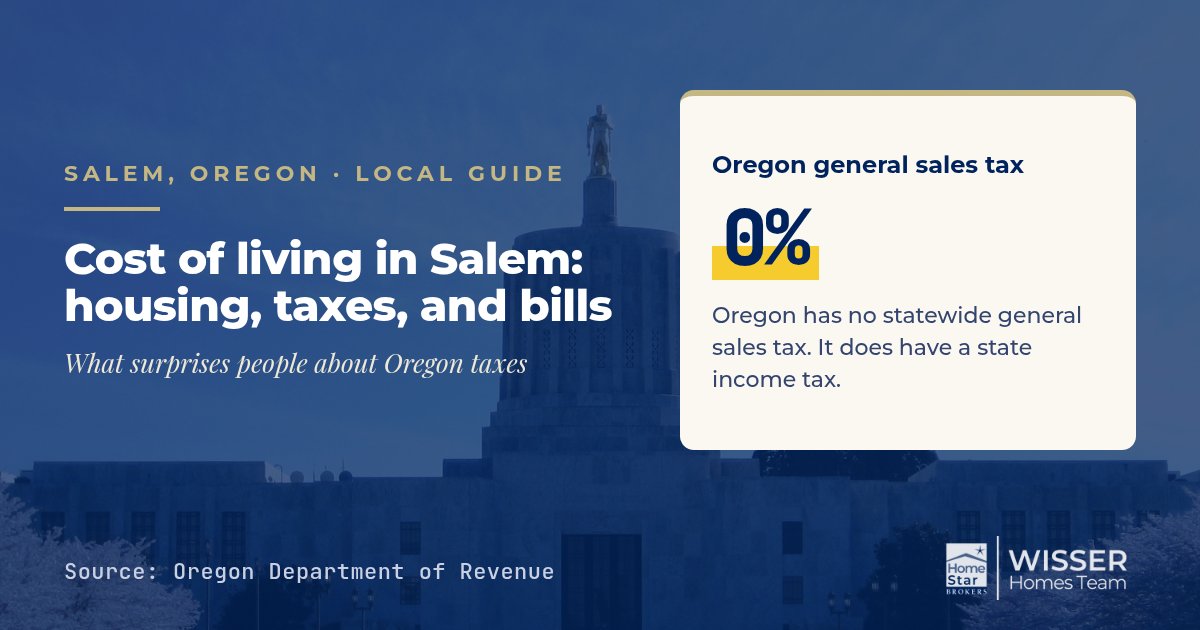
This is the one people love. There's no statewide sales tax in Oregon, so the sticker price at the store is what you pay. If you're moving from California or Washington, that shows up on every big purchase, from a couch to a car.
Oregon does have a state income tax
The tradeoff for no sales tax is income tax. For 2026, Oregon's rates run from 4.75% up to 9.9%, according to the Oregon Department of Revenue. Most working households land in the 8.75% bracket for a large share of their income. The 9.9% rate starts at $125,000 of taxable income for single filers and $250,000 for joint filers.
There's also a small statewide transit tax of 0.1% that comes out of wages. One thing worth knowing if you're comparing Salem with the Portland area: the Metro Supportive Housing Services tax and Multnomah County's Preschool for All tax are local income taxes on higher earners. Living in Salem or Keizer puts you outside both areas, but according to the City of Portland Revenue Division, which collects them, they can still apply to wages you earn while working inside those areas. If you'd live here and work in Portland, ask your CPA how they apply to you.
Everyone's situation is different, so check with a CPA before you count on any of this.
How property taxes work here
Oregon property tax confuses almost everyone the first time. Your bill isn't based directly on what your home would sell for. It's based on an "assessed value" that, under Measure 50, generally can't grow more than 3% a year, plus whatever local bonds and levies voters have approved. Measure 5 also caps certain tax rates as a share of the home's real market value.
What that means in practice: two similar houses on the same street can have different tax bills, depending on when they were built and how they've been assessed over the years. So don't guess from the price. Look up the actual bill for the specific home on the Marion County or Polk County assessor site (West Salem is in Polk County), or ask us and we'll pull it for you.
Utilities: ask for the real numbers
Utility costs depend on the house, the heating system, and the provider at that address. In Salem, water, sewer, and stormwater usually come from the city. Electricity comes from Portland General Electric or Salem Electric, a member-owned co-op, depending on where the home is. Many homes also have natural gas.
The easiest way to get a real picture is to ask the seller, through your agent, for a year of utility history. Winters here are long and gray rather than bitterly cold, so heat pumps, insulation, and window quality show up on the bill more than you'd expect. If a home is on a well or septic, like many properties outside city limits, there's no water or sewer bill, but there is maintenance to plan for.
Insurance and the rest
Homeowners insurance varies by house, age of the roof, and location, so get a quote early in your search, not after you're under contract. Groceries, gas, and day-to-day costs in Salem are a frequent reason people give for moving down from Portland, but we'd rather you compare your own receipts than take our word for it.
Where we can help
If you're weighing a move to Salem or Keizer, or a move within the area, we're happy to walk through a specific home's taxes, utilities, and likely payment with you. Start with a search at wisser.homes/search. If you own now and want to know what your home might sell for, try wisser.homes/home-value-offer, or call or text us at (503) 881-7273. You can also email Gavin@HomeStarBrokers.com.
For the bigger picture on relocating, our guide to moving to Salem or Keizer, Oregon covers planning the move itself.
This post is general information, not tax, legal, or financial advice.
Featured image: Oregon State Capitol, photo by M.O. Stevens / Wikimedia Commons (public domain), modified.